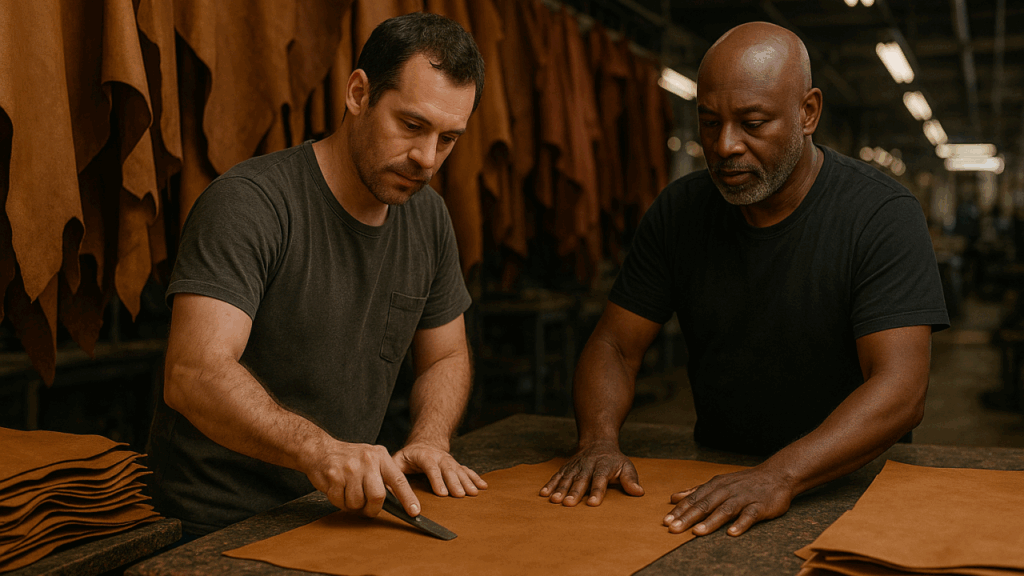
In Narok, a cow is slaughtered. Its hide, once stripped and salted, is sold for a few hundred shillings. Several months later, that same hide resurfaces in a high-end shopping mall in Nairobi—now part of a refined leather handbag priced at 16,000 Kenyan Shillings, sometimes branded with an Italian name stitched into the lining. This transformation isn’t just a striking example of trade imbalance. It is evidence of a larger structural issue in Kenya’s economy—an issue rooted in the way the country has confused supply chains with value chains.
Kenya stands among Africa’s leading producers of hides and skins. With an estimated 18.8 million cattle, nearly 27 million goats, and close to 19 million sheep, Kenya has the third-largest livestock population on the continent. Over the years, substantial investments have been made into the leather sector: more tanneries, better transportation, and the establishment of specialized processing zones. These initiatives seem, at first glance, like the foundations of a strong industry. Yet despite these efforts, only about 2% of Kenyan hides are converted into fully finished leather. The bulk are semi-processed and exported with minimal added value.
The core of the problem lies in a widespread misconception. Kenya has concentrated its efforts on building supply chains, not value chains. Although the two terms are often used interchangeably in public policy and investment discourse, they are not the same. And mistaking one for the other has far-reaching consequences.
Supply chains focus on the movement of goods—getting raw materials from one point to another efficiently. They prioritize speed, volume, and cost, and are essential for coordination and infrastructure. Value chains, on the other hand, emphasize the creation and capture of value at each step of the journey. They involve thoughtful product design, quality assurance, branding, customer experience, and more. Where supply chains serve as the skeleton of an industry, value chains act as its nervous system, determining how it performs and grows.
Kenya has built the skeleton. The country’s leather sector efficiently transports hides from rural slaughterhouses to urban tanneries and on to export markets. However, the infrastructure needed for product development—grading facilities, finishing workshops, prototyping centres, branding support, and retail distribution—has not been developed at the same pace. As a result, the hides flow through a system designed purely for movement, not transformation. Once that supply chain is in place and optimized for exports, it becomes increasingly difficult and expensive to shift its purpose.
This sequencing fallacy—believing that value can be added later, once a supply chain is established—locks Kenya into the lowest value segments of the global leather market. It creates a system that sustains livelihoods but fails to promote upward mobility. Jobs are created, but they remain mostly informal, low-paying, and disconnected from enterprise growth. Kenyan leather may find its way into luxury goods, but the country’s identity and value are lost along the way.
To truly unlock the sector’s potential, Kenya must envision a different future—one built around value creation. Imagine a system where hides are not just collected but graded for quality and purpose. Where tanneries don’t simply churn out uniform sheets of leather, but customize finishes for specific products such as shoes, furniture, or safety gear. Where local design studios prototype high-end goods for both regional and export markets. Where Kenyan brands tell authentic stories, build loyal customers, and command higher prices.
Shifting to a value chain mindset changes the entire logic of how industries are built. It requires grading hides based on quality rather than simply aggregating them by quantity. It means designing tanneries to produce different finishes suited to varied applications—from automotive upholstery to boxing gloves. It transforms efficiency into a tool that protects margins rather than just reducing cost. It demands more than infrastructure; it requires a full ecosystem, including labs for design, centres for quality certification, facilities for small-batch production, and experts in branding and marketing.
Crucially, a value chain approach repositions Kenya from being merely a supplier of raw materials to becoming an owner of its markets. The applications of leather are vast—beyond fashion accessories, it’s used in furniture, automotive interiors, industrial safety gear, sports equipment, cultural artifacts, and luxury packaging. Each of these markets requires a different kind of leather and offers different opportunities for margin and scale. By intentionally designing systems for these varied sectors, Kenya could unlock untapped economic potential.
However, understanding the value chain is only the first step. Implementing it requires new capabilities and tools that traditional supply chain development often overlooks. It demands precise diagnostic tools that can map where value is created and where it leaks out of the system. It calls for structured product development methods, enabling businesses to prototype, test, and position their products effectively in the market. It requires ecosystem mapping to identify who plays what role in the chain and how relationships might be realigned for better outcomes. And it depends on new ways of measuring performance—not just by volume and cost, but by quality, margin, customer loyalty, and brand strength.
These are not generic skills. They require practical, field-tested methodologies and deep familiarity with how value chains function in context—especially in environments where systems are fragmented, incentives misaligned, and local capability uneven. Without this, value chain thinking remains a concept. With it, it becomes a strategy that can be executed.
The leather sector in Kenya is not an isolated case. It exemplifies a pattern seen in many other industries across the continent. Too often, development strategies prioritize logistics and infrastructure—mistaking movement for progress. Without clarity about the kind of value a system is meant to generate, even the most efficient supply chains can trap countries in a cycle of low returns and limited growth.
But the situation is not irreversible. Kenya has the raw resources, the talent, and the entrepreneurial spirit to build competitive, value-driven industries. What’s required is intentional design—starting with the end in mind and supported by the right capabilities to make it work in practice. Instead of asking how to move more material faster, the country must ask: what kind of value do we want to create, and for whom?
Once this fundamental question is answered, supply chains can be built not just for movement, but for meaning. Kenya’s leather doesn’t have to be just another export statistic. It can be the foundation of an industry that creates jobs, builds brands, and tells Kenyan stories to the world.